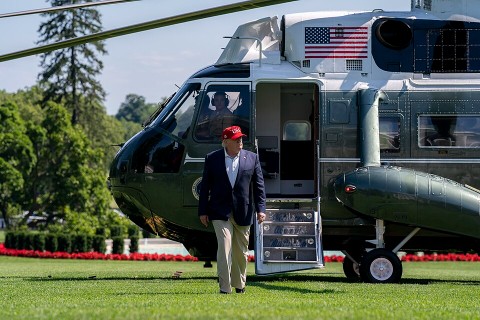
In a move that could potentially unsettle US-China relations, President Donald Trump expressed his intention to engage in direct communication with Taiwan’s President Lai Ching-te on Wednesday. Speaking to reporters at Joint Base Andrews in Maryland before departing on Air Force One, Trump stated, “I’ll speak to him. I speak to everybody … We’ll work on that, the Taiwan problem.” This declaration follows an earlier instance where Trump, after meeting with China’s President Xi Jinping, hinted at such a conversation, dismissing the notion that it was merely a verbal slip.
The US and Taiwan have not engaged in direct presidential conversations since 1979 when Washington shifted its diplomatic recognition from Taipei to Beijing. However, Trump previously broke this long-standing diplomatic tradition when he spoke to then-Taiwan President Tsai Ing-wen as president-elect in 2016, resulting in a formal complaint from China. Despite this, Taiwan’s foreign ministry indicated enthusiasm for such a dialogue, expressing that President Lai would be pleased to speak with Trump.
China remains firm in its stance regarding Taiwan, considering it a part of its territory and not ruling out the use of force to achieve unification. The nation has been particularly irked by the US’s enduring military support for Taiwan, which aims to deter any aggressive Chinese military actions. This tension is further complicated by ongoing discussions within the Trump administration regarding a significant arms sale to Taiwan, which Trump has described as a “very good negotiating chip.”
With Taiwan being the fourth-largest trading partner of the US, underscored by its pivotal role in supplying advanced semiconductors, any direct conversation between the US and Taiwan is likely to provoke Beijing. China has reportedly delayed approval for a visit by the Pentagon’s undersecretary of defense for policy, Elbridge Colby, to exert pressure on Trump regarding the arms deal. Beijing’s stance is clear: until Trump reaches a decision on the arms sale, Colby’s visit remains in limbo.
President Lai has expressed his commitment to maintaining the status quo across the Taiwan Strait, attributing tensions to China’s military expansions in the Indo-Pacific, while emphasizing Taiwan’s pursuit of democracy and freedom. As US law mandates support for Taiwan’s defense capabilities, bipartisan calls from US lawmakers urge the Trump administration to continue arms sales. This ongoing geopolitical chess match highlights Taiwan’s strategic significance amid the US-China power dynamics.