
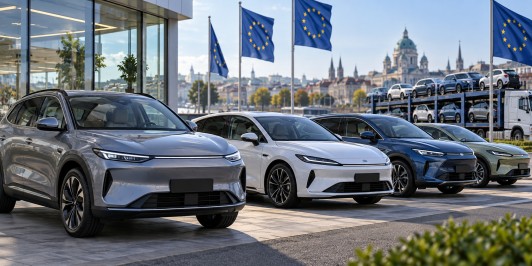
The European Union is facing a mounting challenge in its automotive market as Chinese-made hybrid vehicles witness a remarkable surge in sales. With hybrid vehicles now making up nearly 37% of the European car market, the influx of Chinese imports is intensifying competition for local manufacturers and prompting actions from EU regulators.
Chinese hybrid vehicle sales in the EU have experienced an exponential rise, climbing from a mere 659 units in 2022 to a staggering 160,662 in the first seven months of 2026. Similarly, plug-in hybrid sales from China surged from 56,706 units in 2022 to 217,764 over the same period this year. This growth spurt followed the EU’s 2024 decision to impose anti-subsidy tariffs on Chinese electric vehicles, a move that did not extend to hybrids.
In response to the growing market share of Chinese automakers like BYD, Chery, and Leapmotor, the European Commission has requested that China voluntarily curb its hybrid vehicle exports to the region. Should negotiations falter, the EU may implement safeguard measures, potentially including quotas, to protect its domestic industry.
BYD and Geely are among the Chinese manufacturers making significant inroads in the European market. BYD’s sales reached approximately 177,000 vehicles, while Geely, the largest Chinese automotive group in Europe, sold about 205,000 vehicles during the first eight months of 2026. Despite these figures, European brands still hold the majority market share.
The rise of Chinese hybrid imports comes amid the EU’s efforts to counter a growing trade imbalance with China and safeguard the competitiveness of its automotive sector. As the bloc navigates these challenges, the future of Chinese hybrid vehicles in Europe remains a critical focal point for policymakers and industry stakeholders alike.