
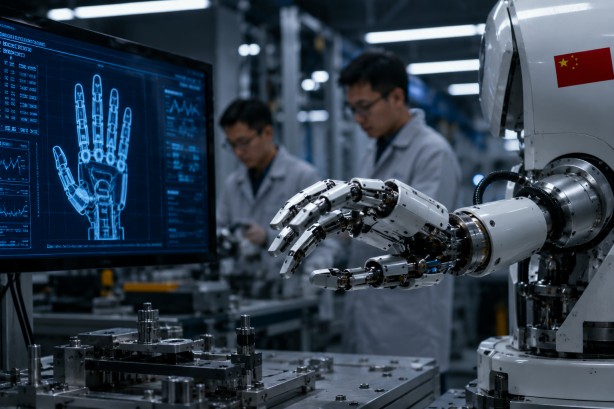
In China, robotics companies are ramping up their efforts to develop highly dexterous robotic hands, which are considered one of the most challenging aspects of advancing humanoid robots. These startups are leveraging artificial intelligence and China’s robust manufacturing capabilities to build robotic hands that can handle intricate tasks like grasping objects, using tools, and performing everyday activities. The successful development of this technology is expected to significantly enhance the practicality of humanoid robots in various sectors, including homes, healthcare, and industry.
Creating robotic hands that can match the flexibility and precision of human hands presents a formidable challenge. Experts highlight that it is far more complicated than constructing the rest of a humanoid robot. Developers face hurdles in both hardware and software, needing to integrate compact motors and sensors while also enabling the robots to comprehend touch, pressure, and complex movements.
China’s position as a global leader in robotics manufacturing is bolstered by its advanced supply chain and government-supported initiatives focusing on “embodied AI.” This thriving robotics ecosystem is fueling rapid innovation, with companies advancing in areas such as robotic hands, wearable sensor gloves, and AI systems that learn human movements from real-world data. The country’s concentrated efforts in this field are accelerating progress toward more sophisticated robotic hand dexterity.
Researchers assert that enhancing the dexterity of robotic hands is crucial for developing robots capable of performing a broad spectrum of everyday tasks, from household chores to industrial operations and advanced prosthetic applications. The ability to replicate human hand movements with high precision could revolutionize not only personal and professional environments but also significantly benefit individuals with disabilities.
Industry leaders suggest that as AI and robotics technologies continue to advance, humanoid robots may eventually integrate more seamlessly into human environments. This evolution could unlock new opportunities across various sectors such as manufacturing, healthcare, and consumer services, facilitating a more natural and efficient interaction between humans and machines.